Saturday, August 4, 2012

SNOWS OF YESTERDAY

IF YOU DON'T BELIEVE our globe is warming, you might want to visit a retreating glacier or two.  Here's a view of the beautiful Zmutt valley, shown below in a classic panoramic photo from September 1997.


Earlier this week we were invited to a mountain picnic in the village of Stafelalp, high in the left wide of the Zmutt valley on the back side of the Matterhorn. 

Here's a view of the mountain taken from the small group of huts at Stafelalp on 31 July. As you can see, mountain huts tend to cluster together on the flat spots, and you'd better be on good terms with your neighbors!


A closer look at the mountain shows the lack of snow cover -- with bare rocks showing on the former ice climbing diagonals at both the left and right sides of the photo. Compare with the heavy snow cover in the September 1997 view. 


Looking to the glacier across the valley, we could watch the snow retreat, with multiple streams of water running merrily down across the rocks. As you can see, the ample snows of yesterday are vanishing. 


Thursday, August 2, 2012

BLUMEN BLOOMIN'

IT'S A GREAT YEAR for flowers here -- Europe has been drenched as the U.S. has suffered heat and drought. Geraniums fill every container -- from the old horse-drawn carriages on  the hotel porch ... 


to the window boxes hanging from  the balconies


of hotels


or antique Swiss dwellings now used for storage.


There are geraniums in wild arrays of form and  color...


And even in the vegetable gardens, delphiniums and edelweiss bloom among the onions.


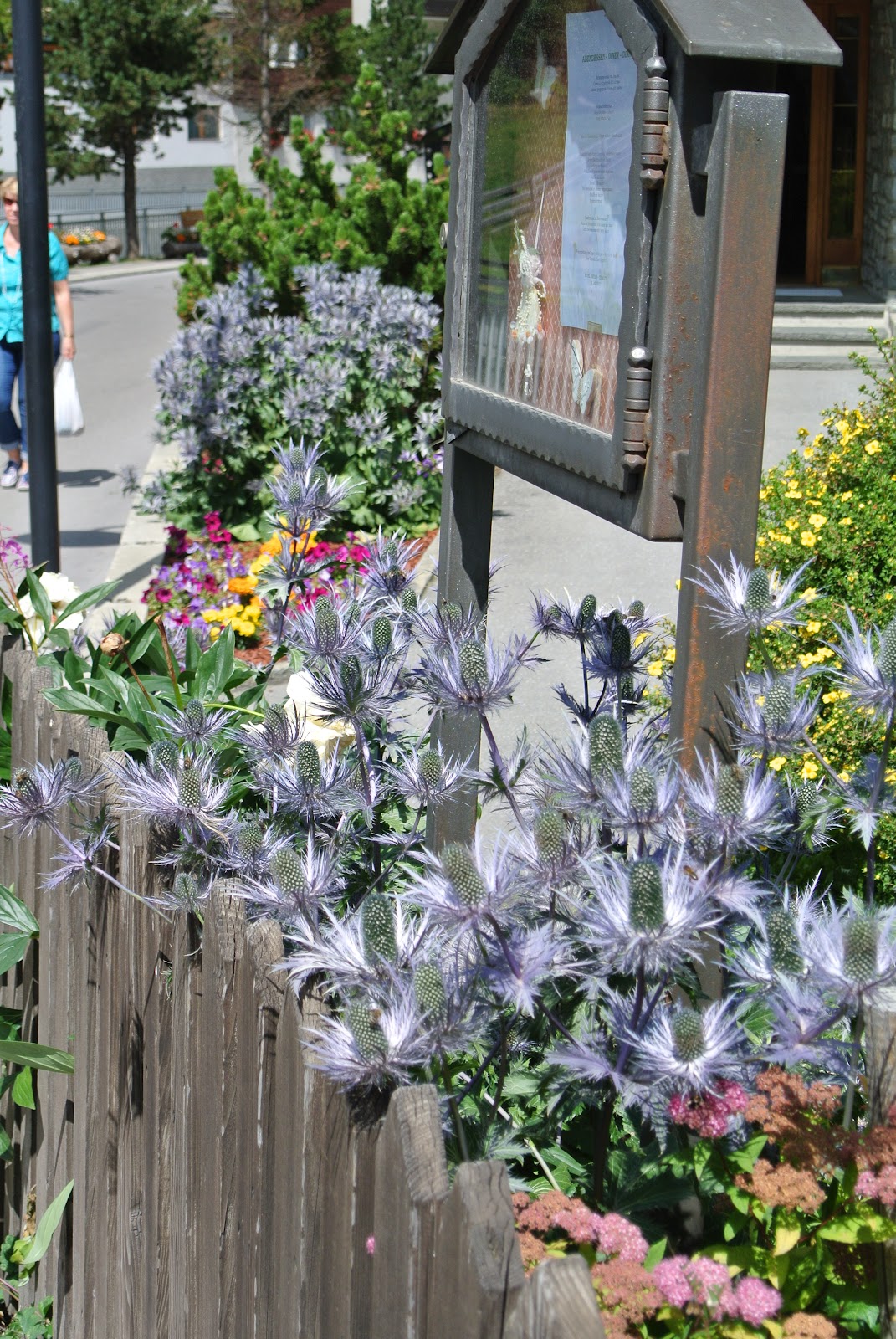
Sweet william, astilbes, and sea holly edge the lawns...


and line the fences.


Hollowed-out trees along the sidewalk make colorful containers...


At the florist you can buy cultivated edelweiss or lavender to add a centerpiece to your outdoor table,  a pot to  soften your steps, or a stoneware sculpture to add a bit of whimsy. 


It's Blumen everywhere in Switzerland.


ZERMATT FOR KIDS

THERE IS A DISNEYLAND aspect to our world these days, and the natural wonders of the world, the everyday scenes of Zermatt, have been translated into children's visions.


Like the Olympics, Zermatt must have its  mascot, and so we have Wolli, the upright lamb of the Wallis (Valais canton), a super-sheep who wears a Matterhorn emblem on his chest, with red-and-white suspenders sporting the stars of the canton's flag.  This Tourismusbüro picture is shot in front of the Leisee ("the Miami Beach of Zermatt"), a kid-friendly lake with sand beach just a short tram-ride or woodland hike from town. 


But there are kid-friendly sights all over. For instance,  we found Wolli watching over the playground in the center of town . 


And the town Arzt, or doctor, has a green band-aid decor on his bright orange Fiat wagon -- one of the few gas-driven vehicles in town.  


Even the famous Swiss "green cross" on the sign near his office door is composed of crossed green band-aids.


As in any-self-respecting tourist town, food is a principal attraction, and this restaurant sign tells us that even the Matterhorn itself gets hungry -- in Kanji!


Stuffed critters are a popular buy for kids and adults alike: the smaller versions of St. Bernards and the local field rodents called marmottes are seen hanging from backpacks all over town.


Again, it's not only for kids, because the ubiquitous ice cream stands serve young and old alike.


And the symbol of the local bakery is not the gingerbread man, but the life-size Swiss doughboy with a pretzel ear.


I suppose there's a little kid in all of us.


Sunday, July 29, 2012

MATTERHORN NIGHT, MORNING, AND MORE

THE SUN GOES DOWN as we settle in, and soon, from our balcony, we can watch the moon rise  over the ridge next to the Matterhorn. There are two blue lights on the ridge: one at Trockener Steg station on the left and another at Schwarzsee on the right.  To our (sleepless) amazement they suddenly changed at 2:45 AM to flashing red and green for a few minutes.  When we asked why, we learned that anyone with a charge card can phone a certain number and, for a fee, change the lights to any one of seven colors.  Of the $50 charge, a small amount goes to a charity for families of fallen Zermatt mountain guides. 


Next morning, I woke early to see what the new day had brought to The Mountain.  Automatic camera settings made it hard to photograph, with shadows in the valley and daylight blazing above the ridge. What a contrast with the night photo! With the Matterhorn presiding over all, the valley ends in a broad swath of hiking/skiing trails. In summer, you need months to explore them all; in winter you can cover more terrain and traverse most of them in just a couple of exhausting weeks.


But the weather never stays the same for long in the mountains.  As the day wears on, the clouds gather, and by the end of the afternoon, the vast view is socked in. Hard to believe it's the same valley. No more Matternhorn.


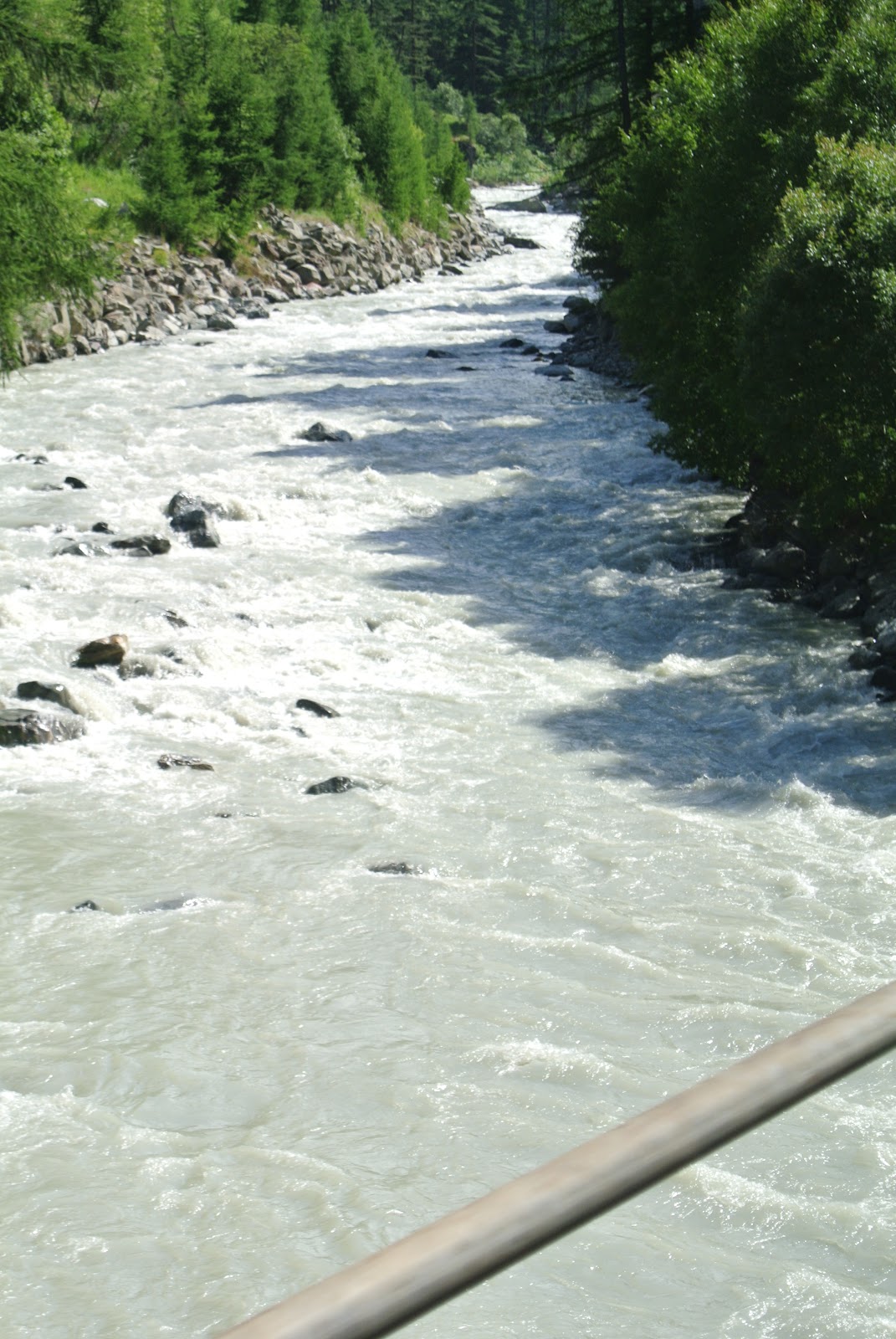
In the streets of town pedestrians run for cover, while rain pelts down on the upper reaches of the Vispa river. 


FINDING ZERMATT, 2012

THE MATTERHORN EXPRESS climbs briskly,  and follows the river Vispa up the valley to Zermatt. 


Sleepily, we drag the camera from its bag and aim it upwards to the peaks far ahead. The train roars over bottomless chasms spanned by temporary wooden bridges.


Drawing closer, we can see the peaks and river in a single view -- though it's frustrating to shoot from the fast-moving train window.


Soon we pass the 1991 rockslide at Randa, where Nature is slowly restoring the damage. We notice there may have been a new, smaller slide near the top of the slope. 


Near the top, the valley broadens out. At home in New England, we brag about our 4000-foot hills; Zermatt has 38  that rise more than 4000 meters.  The camera strains to capture peaks and valleys in the same shot. 


One last glimpse of  snow fields ahead...  


as we enter the final tunnels that take us into the Zermatt bahnhof. 


Saturday, February 11, 2012

WHAT'S THE SEASON?

TODAY WAS SUPPOSED to bring 3 inches of snow –  our first real taste of winter.  Instead, the storm veered off, and we had a sunny day in the mid-30s. Last year at this time, we were buried in six feet of snow; today I noticed snowdrops blooming as I pulled out of the driveway.  


The early iris (Reticulata) that normally warm themselves in the March sunshine are poking up; I fear they’ll get a cool reception before they bloom. And the hellebores, which have never made a move til late April, are swelling their purple  buds.


It’s feeling more like southern Pennsylvania or Delaware than northern Massachusetts.

Wonder if we'll get to use that shiny new snowblower that seemed so necessary last summer. Or did the purchase jinx our winter?

Saturday, January 28, 2012

EARTHLY LOVE

WELL AHEAD OF EARTH DAY, NASA this week released this stunning high-definition image of Earth, taken from the newly launched Suomi satellite. What a glorious sight -- you can just feel the breezes wafting over the turquoise waters in the Gulf of Mexico shallows.


And the media are using the stunning images to bolster the case for the group who've been called "the deniers." A provocative op-ed in yesterday's Wall Street Journal, signed by 16 climate scientists, ran a related NASA photo  to assure us there's "no need to panic" about the dangers of CO2 in global warming.

In a follow-up online interview one of the signers, physicist William Happer of Princeton, argued that the UN's IPCC (Inter-Governmental Panel on Climate Change) computer models greatly exaggerate the predicted effects of CO2 on global warming, and we need to continue to monitor the situation for "decades" before the science can be definitively settled. The piece, by the way, spoke exclusively of CO2, and did not mention other environmental pollutants. 

What's an average citizen to believe? Empirically, the weather seems weird lately. Clearly the glaciers are receding all over the globe with startling speed: I have witnessed that personally. And I frequently read that only slightly warmer ocean temperatures can cause violent storms. The WSJ article did not mention this, but I have read elsewhere that the insurance industry is building that information into new models.

There are at least two scientists I plan to read. The first is a social scientist, Maxwell T. Boykoff, who argues in "Who Speaks for the Climate?" (November 2011) that the media's handling of climate change depends on how the issues are framed. The other is a climate scientist: Britain's Mike Hulme, author of  "Why We Disagree on Climate Change" (May, 2009).  Hulme says what we need is "dis-census," not consensus -- a multidimensional conversation about the physics of climate change, as well as responses to the humanitarian, ethical, and social issues that arise as we try to understand how to live on our planet.