Friday, August 14, 2020

NOT IN ZERMATT

Americans are not welcome in Europe this year, so our annual vacation at [cool] high altitudes is not available. We are trying to find comfort in the flourishing green spaces of Carlisle (below), tall drinks of iced water and the books we've been meaning to read, with frequent trips to local farmers' markets.


Speaking of farmers' markets, Atlantic magazine send us "nine poems for fraught times", including the following link to the Poetry Foundation website:

From Blossoms 

BY LI-YOUNG LEE

From blossoms comes
this brown paper bag of peaches
we bought from the boy
at the bend in the road where we turned toward   
signs painted Peaches.

From laden boughs, from hands,
from sweet fellowship in the bins,
comes nectar at the roadside, succulent
peaches we devour, dusty skin and all,
comes the familiar dust of summer, dust we eat.

O, to take what we love inside,
to carry within us an orchard, to eat
not only the skin, but the shade,
not only the sugar, but the days, to hold
the fruit in our hands, adore it, then bite into   
the round jubilance of peach.

There are days we live
as if death were nowhere
in the background; from joy
to joy to joy, from wing to wing,
from blossom to blossom to
impossible blossom, to sweet impossible blossom

Li-Young Lee, “From Blossoms” from Rose. Copyright © 1986 by Li-Young Lee. Reprinted with the permission of BOA Editions Ltd., www.boaeditions.org.


YUM. The joys and comforts of home.

Sunday, July 21, 2019

REVISITING THE MOON

THIS WEEK WAS THE 50th ANNIVERSARY of the first landing of mankind on the moon, on 20 July 1969. It was fun to be in Zermatt, where the sky reaches down to touch you on a clear day, to celebrate this awesome achievement. Plus the gods were kind enough to celebrate the event at the full-moon portion of the satellite's monthly cycle, shown starting on July 16 on the chart.

Moon chart from moonconnection.com

A comparative close-up through the camera showed a mass on the moon that corresponded to a labelled image of the moon, indicating the location of the Mare Tranquillitatis -- the Sea of Tranquility where astronauts Armstrong and Aldrin had landed. It spurred the imagination to the breaking point.


On Earth, the Alps form a bowl at the south end of the valley. The tall mountains at the eastern end -- the Dom and the Breithorn, not shown in the photo -- are on the left. The queen of all the Swiss Alps, the Matterhorn, rises majestically on the right (western) end of the vista. (Cervinia, Italy is over the horizon to the south.) When you're lucky (and we were this week), the clouds do not block the view of the moon, which takes several hours to cross the "ridge" of land visible from downtown Zermatt. So I parked myself on the balcony to watch the far-away moon move from east to west on this anniversary dawn.


It was an interesting interlude. The patch of sky before me was immense; the Matterhorn, not-exactly-shabby. In context, the moon seemed so far away, and myself, sitting on a small balcony in Zermatt, seemed -- in the scheme of things -- tiniest of all. The universe so vast. We humans so fragile. Quite a humbling experience.


Saturday, July 20, 2019

A SWISS WELCOME

THE JOURNEY IS MORE EPIC each year. This time, the remnants of Hurricane Barry were due to arrive in Boston just at take-off time, and the weather people were spot on. We taxied to the runway to join the take-off queue. A couple of small planes departed, then the Lufthansa 747 ahead of us was given the green light. We moved to the head of the line. Where we waited, as a number of smaller planes were permitted to come to ground -- a blessing, we were sure, as black thunderheads moved in from the west and large raindrops began to splatter across the plane's porthole windows,

"We are being held," the pilot informed us. "A serious squall line is passing through. We'll turn off the engine and wait here until the storm subsides." And we that, Boston shut down Logan airport. What followed was new to me, though the pilot had a here-we-go-again quality to his short speech. Outside the plane, night had fallen suddenly at 5:30 p.m. with rain obscuring the view entirely, except for forked, intense lightning strikes and thunder that arrived only seconds after each flash. The passengers, who had been chatting nervously, were respectfully silent. We sat through this excitement for 20 minutes or so, when the darkness lifted. Across the field, a fire truck was responding to a call. "Having way too much fun" is one ironic way to describe it. Finally, the pilot called the engines to life, and I wondered if others joined me in asking myself whether it was a good idea to chase this storm across Boston Harbor.

As it turned out, the pilot knew just what he was doing. In a steep climb, our low-mileage Airbus 300 shrugged off some minor shudders as we rose above the storm and outpaced it. Our business-as-usual flight landed in Zurich just a few minutes late, and soon the SBB Intercity 8 train was whisking us across the country to Visp.

It's a wonderful journey when it ends at the Christiana Hotel in Zermatt! Michel Franzen, part of the third generation to run the hotel, had arranged a simple soup-and-salad luncheon to refresh us when we arrived.

Before we knew it, we were enjoying a welcoming bottle of iced Les Murettes, a local Swiss wine, along with a basket of fruit and chocolates as we relaxed on the balcony looking out at the Matterhorn. (More about that spectacular sky later.)


Sunday, July 14, 2019

WHAT ARE WE COMING TO?

It's official: the #1 issue facing humankind is the state of our planet Earth. The well-being of the world's population, the quality of life for future generations, and the course of world history all depend on entering a sustainable relationship with our environment. 


World leaders, struggling economies, developing countries, and countries at war -- we're all in this together. If we have a "common enemy" to unite us all, it's not arriving from outer space. It's already here, and -- to quote the great Walt Kelly of the gone-but-not-forgotten comic strip Pogo: "We have met the enemy and it is us."


Environmental writers have invented new names to describe our planet's situation -- wild, made-up permutations such as Eaarth or Eairth. 


Eaarth: An altered planet

According to Bill McKibben, pioneering environmentalist and head of 350.org, a  worldwide movement to control global warming by limiting atmospheric carbon dioxide emissions to 350 ppm, the climate battle is settled science. He's been writing books for 30 years -- his debut, The End of History -- was published in 2009. We no longer need to worry about the arrival of climate change: we're living it. McKibben continues to warn of climate change and its effects on human society. The name Eaarth, for example, was coined to indicate that our planet has been fundamentally altered by human activity. His many books form an important commentary on the staatus quo of life on earth.

The 350 ppm rollback has not been achieved. Earlier in this decade, in fact, the NY Times reported that Beijing had posted a "crazy bad" reading of 775 ppm.  And China is now burning more coal than all the rest of the planet combined.


A new website, CO2 Earth, was recently launched to report the daily CO2 readings recorded at Mauna Loa Observatory in Hawaii. It's worth a visit and a conversation.


Two more resources to consider

Two additional names and debuts to celebrate: a 2016 film from Diana Beresford-Kroeger (Call of the Forest)  and an amazing catalog of ideas from Whole Earth catalog contributor Paul Hawken (Drawdown, 2017) add inspiring ideas to the issue of climate change.

Beresford-Kroeger has consummate credentials for a forest activist. Raised in the Irish Druid tradition (Ireland is a land of forests that has lost almost all of its old-growth trees), she  learned the ways of the Celtic triad of mind, body and soul. This included the philosophy of healing, the laws of the trees, Brehon wisdom and the Ogham alphabet, all of it rooted in a vision of nature that saw trees and forests as fundamental to human survival and spirituality. Out of that huge, holistic vision have come the observations that put her at the forefront of her field: the discovery of mother trees at the heart of a forest; the fact that trees are a living library, have a chemical language and communicate in a quantum world; the major idea that trees heal living creatures through the aerosols they release; that they carry a great wealth of natural antibiotics and other healing substances; and, perhaps most significantly, that planting trees can regulate the atmosphere and the oceans, and even stabilize our climate. This film is not to be missed. It's based on scientific research published in her encyclopedic Arboretum America, about Northern American woody plants and perennials,and Arboretum Borealis, which covers plants of the global boreal habitat.


The 80 projects summarized in Drawdown include initiatives in energy, food, women/girls, buildings/cities, land use, transport, and materials science. The ideas presented are being enacted throughout the globe, and are ranked in terms of cost-effectiveness - both in carbon cost and dollar cost. Prepare to be totally engaged. If pursued with discipline, they offer a credible path to reach drawdowns - the reversal of greenhouse gases that have built up in our atmosphere primarily from the burning of fossil fuels - coal, oil, and natural gas. Entrepreneur and activist Hawken, along with  and a who's who of scientists and foundations, stand behind this awesome publication. There is even an online set of references for those who ask: What can I do to help?

Citizens' groups play a role
What if government agencies, possibly for political reasons, decline to impose or decide to remove environmental regulations and thereby endanger the climate? What options remain? Rapidly growing citizens' groups, such as Mom's Clean Air Force, co-founded by Dominique Browning in the U.S., have stepped up with rallies and projects to raise awareness and to protest rollbacks of the Clean Air, Clean Water and Endangered Species Acts established as part of the Environmental Protection Agency legislation. 


But will rallies and citizen pressure provide the political will needed when governmental authorities deny climate realities?

Eairth: Embracing the sensuousness of place 

A consummate spokesman for an optimistic future is the ecological philosopher and activist David Abram, whose two books -- The Spell of the Sensuous and Becoming Animal -- ask us to experience the true magic of nature from our deepest animal selves. He was one of the first nature writers to broaden the definition of our planet to include "the more-than-human world."  His writing is as luminous and compelling as clear air or clean water. I continue to buy his books because I'm forever giving away my own copies and then need to replace them. 

What will it take?

April 22, 2020 will mark the 50th anniversary of the original Earth Day in 1970. As just one of the myriad small community groups who support the "friends of the Earth" agenda, our local garden club is planning a community event to commemorate ongoing efforts to honor and befriend the planet. We will also focus our outreach programs to address issues such as sustainable gardening practices; concern for native species, pollinators, and biodiversity; the inclusion of fruit and nut shrubs and trees in our home garden "bioplan"; carbon sequestration; implementing energy-saving initiatives; seed swapping and saving -- the list goes on. We hope to raise community awareness that all these efforts make a difference. We're celebrating the Earth by gardening as if the planet depends on it. 

We are fortunate to have a wonderful local non-profit called Grow Native Massachusetts. Their motto is: "Every garden matters -- Every garden counts." They sponsor ecological workshops (for locals) as well as a fabulous series of talks by leading garden practitioners and researchers (with online videos for anyone who has an Internet connection). Check them out. They're answering the urgent call of famed biologist and author E.O.Wilson, as laid out in Half-Life: Our Planet's Fight for Life (p.3). It's called the Half-Earth proposal. It's radical, and it runs like this: "...by setting aside half the planet in reserve, or more, we [can] save the living part of the environment and achieve the stabilization required for our own survival." Wow -- Are we up for (or is it "down with"?) that?

ITS NAME IS WRIT IN WATER

LOOKING FORWARD TO RETURN to Zermatt, where it's cool and the skies are open. The mountains host  their share of primal storms, but the community has  created a building code that can withstand the weather. How great to live in a world of ample water, water that's doing good work -- refreshing, powering, sustaining and soothing. The Christiana hotel in Zermatt sits next to the Vispa river. It's frozen in winter, but in summer it provides cool evenings and a delicious white noise that lulls you to sleep. Waking, it's sometimes hard to tell whether a powerful rainstorm has moved in, or whether it's just ol' Ma'am river roaring and rolling rocks down from the glaciers above.  As you can see,the Swiss have found it prudent to corral the waters into a concrete channel -- neatness counts.


Wherever you travel in the mountains there are pounding streams, noisy waterfalls, trickling tributaries over soggy slopes. There is generous snow melt most years, but the rivers "normally" continue into the fall by residual melting of  ancient glacial shelves. But  now those shelves are retreating.  What will happen when the glaciers are gone?

Tuesday, January 22, 2019

GOOD-BYE AND THANK YOU, MARY OLIVER

A FRIEND posted this poem, which I had not seen. A message for our worrisome times:

“I Worried" by Mary Oliver

I worried a lot. Will the garden grow, will the rivers
flow in the right direction, will the earth turn
as it was taught, and if not how shall
I correct it?

Was I right, was I wrong, will I be forgiven,
can I do better?

Will I ever be able to sing, even the sparrows
can do it and I am, well,
hopeless.

Is my eyesight fading, or am I just imagining it,
am I going to get rheumatism,
lockjaw, dementia?

Finally I saw that worrying had come to nothing.
And gave it up. And took my old body
and went out into the morning,
and sang.”
                              -- From "Swan" (2012. Her 20th book)


And now she needs to worry no more. But we shall miss her songs...


Saturday, January 19, 2019

STARTING ANEW


Since much of this blog was composed during summer vacation, I've neglected those important "other" seasons at home. In the past year, I've also become enchanted with the passing seasons, as catalogued by the above example from amazing Grant Snider. He's a delightful artist, down-to-earth and airborne philosopher, and author of the amazing "The Shape of Ideas" -- a book that can change your life. He was also an orthodontist, when last I looked, to pay the bills. You can follow his work at his website and the social media sites listed there. You can even make a donation at Patreon if you want to support his creative urges.

***

So here we are, sitting among the bare trees in mid-January, waiting for the wallop of the winter's first storm. Rushing to pick up the last of the downed tree limbs, store anything that needs to be put in its place, filling the bird feeders, wishing there had been more time in the fall...

Now we will hunker indoors, and watch the show through the sliding doors that overlook our frozen landscape. And wait for birds to swoop down from the trees to snatch their seeds. As the squirrels leap from bare branch to branch.

Tuesday, January 30, 2018

CATALOG DREAMING

Today a small snowstorm just dusted the leaf litter on the hill outside the bedroom window, traced the bare arms of the maple tree with white, and sent me straight to the seed catalogs. There I found joy. Hudson Valley Seed Company -- the folks with the delightful varieties and the artful packages that celebrate "the art of the seed" -- made me yearn for the season beyond the snow. 


In the mix I found a wonderful tomato for sun-drying: Organic Principe Borghese. The catalog graphic shows hollowed-out tomatoes, ready to dry, along with an anecdote that made me laugh out loud.  


Organic Principe Borghese comes with a hearty endorsement from Diane Greenberg at Catskill Native Nursery, who wrote, "Personally, I love Borghese. But sometimes people don't know how it should be used. They try to eat it like a cherry tomato and say, 'It was sooo dry and tasteless...' I have a good friend who has a little takeout restaurant in Lanesville and she makes the most wonderful dried tomatoes and sauces from Borghese.

"The best thing about Borghese is that they are perfect for drying in the hatchback of my Subaru Outback", she continues. "No other tomato dries so fast. I just cut them in half, sprinkle with salt and lay them on a parchment covered cookie sheet with some basil. I then place them in the back of the Subaru on a hot sunny day. Usually they are nicely done by late afternoon, plus the car smells like a ripe tomato." 

Well, I have no Outback, but I do have a vintage Forester and a very sunny driveway, so I can't wait 'til summer to try this quick-and-easy recipe!

Another new introduction --Mikado, formerly Turner Hybrid -- grabbed me, not with a snazzy new commissioned-art cover, but because of the graphic from the original 1890's seedpack.


GRAPHICS FROM THE HUDSON VALLEY SEED SITE

And why in the world does this remind me of 2018 politics? CAN'T WAIT to get back out to the garden.


Tuesday, August 1, 2017

AUGUST 1: SWISS NATIONAL DAY


August 1, 1291 is celebrated throughout Switzerland as the country's birthdate. On that date, representatives from the cantons of Uri, Schwyz, and Unterwalden met in Rutli Meadow in the canton of Schwyz to pledge the Oath of Confederation (or the Oath of Rutli Meadow, depicted below), long believed to be the country's founding document.


The Museum of the Swiss Charters in Schwyz houses many documents that tell the story of the Old Swiss Confederacy: the politics of alliance between the “confederates”, their many conflicts and compromises, life in the Middle Ages, and of course the famous military battles. History and myth are presented as two sides of the same coin, illuminating the Swiss spirit and the country's role in the family of nations.

Although the old confederacy was replaced with the modern Federal State in 1848, the Swiss continue to honor their legacy as one of Earth's earliest republics. Wikipedia traces their long, complex history.

Aug. 1 fireworks over the village. We watch the display from the hotel terrace -- oohing and aahing with the other guests. (Notice the outline of the night-time Matterhorn at left). Then we return to our own balcony, where we are bombarded by competing rockets launched from each sector of town,  far into the night.

Traditional August 1 rituals in each village include display of national and cantonal flags (below; Zermatt is in the canton of Valais/Wallis) with ancient dress, musical performances, and sharing of the wonderful Swiss "essen und trinken." Celebrations include joyous ringing of village church bells, followed by fireworks displays (weather permitting), which boom and echo down the canyons here in Zermatt.


I'm updating this page in 2019, and it's worth saying a few words about the Swiss government, since we in the States have had such a painful civics lesson in the past few years.

The Swiss Federal Council is the seven-member executive council that serves as the collective head of state and of government of Switzerland. While the entire council is responsible for leading the federal administration of Switzerland, each councillor heads one of the seven federal executive departments. The position of President of the Swiss Confederation rotates among the seven councillors on a yearly basis, with one year's Vice President of the Federal Council becoming the next year's Confederation President.

While the Swiss drew heavily on the United States Constitution for the organization of the federal state as a whole, they opted for the collegial rather than the presidential system for the executive branch of government. This accommodated the long tradition of the rule of collective bodies in Switzerland. Under the Ancien Régime, the cantons of the Old Swiss Confederacy had been governed by councils of pre-eminent citizens since time immemorial.

I love this. According to the Swiss order of precedence, the President of the Confederation is "merely" the highest-ranking Swiss official. He/She presides over Council meetings and carries out certain representative functions that, in other countries, are the business of a head of state. In urgent situations where a Council decision cannot be made in time, s/he is empowered to act on behalf of the whole Council. Apart from that, though, s/he is a primus inter pares, having no power above and beyond the other six Councillors.

The collegial system of government has found widespread adoption in modern democracies in the form of cabinet government with collective responsibility. So much for strongman (or heaven forbid,woman) autocrats!  The U.S.could do well to take a cue back from the Swiss.

Monday, July 31, 2017

HERE'S LOOKING @ YOU, CH-3920

IF IT'S BEEN A FEW YEARS since you visited CH-3920 Zermatt, be prepared for a small city, not a village, with 100+ hotels, tens of thousands of visitors, endless construction, and disappearing greenery within the town. Today being a special one, we planned to lunch at the Schoenegg, or "Beautiful Corner" hotel, where we could see how the town is changing.


Luncheon was simple but memorable: First, some good Swiss white Fendant. Then on to a delicious soup: on one side of the table, Andalusian gazpacho, crisply cold and served with a side of violet-adorned sundried tomato/olive tapenade on crackers; and on the other, creamy morel mushroom soup-of-the-day, just singing with forest flavor. (Why must we settle for dried porcinis at home; morels do grow in New England!) To follow up, there were two types of steak tartare: the original, brimming with onion, Worcestershire sauce and tomato paste; and the Asian, zesty with fresh ginger, sesame and green onion. In keeping with today's passion for vertical food, the tartares were each planted with a sprig of parsley and another violet!

Looking out at Zermatt through the new glass railing, you can see the base of the cloud-wrapped Matterhorn, the new copper roof of the Zermatterhof Hotel (to the right of the tall tree just above the wine bucket), the Monte Rosa Hotel across the street and the Mt. Cervin a couple of buildings to the right (look from the menu card up past a green swath of grass to the building whose top floor is all dormer windows). Note the Vispa River, in its concrete banks, bounding through the center of town (just to the right of the menu card.) And notice the "hotel creep" on the side of the far hill.


A few more shots show the river continuing its way through town and down the valley. The turquoise horizontal swath in the center is ALL that is left of the original town center -- just a few tennis courts/ice hockey rinks surrounded by luxurious apartments and shops. And the plywood rooftops at right are the main shopping complex opposite the Bahnhof (across from the Gornergrat Bahn terminus, which is the large, flat roof on the cream-colored building in the vertical picture).


The construction you see immediately below the Schoenegg porch is 7 Heavens, a new luxury condo development we'll cover in another post. Can you see the river wending its way? Happily, the steep hillside across the river is too avalanche-prone for building (and has no Matterhorn view). But it's good for some other things, which will also be the subject of an upcoming post.

Looking across the lower town, you can see the Bahnhof with two red Glacier Express trains waiting on a siding for their trip across the Alps -- ultimately to St. Moritz. The lower part of Zermatt, once sparsely built, is filling in as well. (The panorama concludes with the beautiful Schoenegg balconies at the right.)


Thursday, July 28, 2016

BIRDS OF ZERMATT

A COUPLE OF YEARS BACK, we posted an entry that showed a chainsaw carver working on a wooden eagle at the Furi station just above town.  In more recent walks, we've found additional birds that could be the work of the same carver.

FOR EXAMPLE, an old farm building in Furi is home to a pair of carved birds – an owl and a falcon or some other raptor – perched on a ledge near the door. Presumably they help to keep the barn safe from rodents.


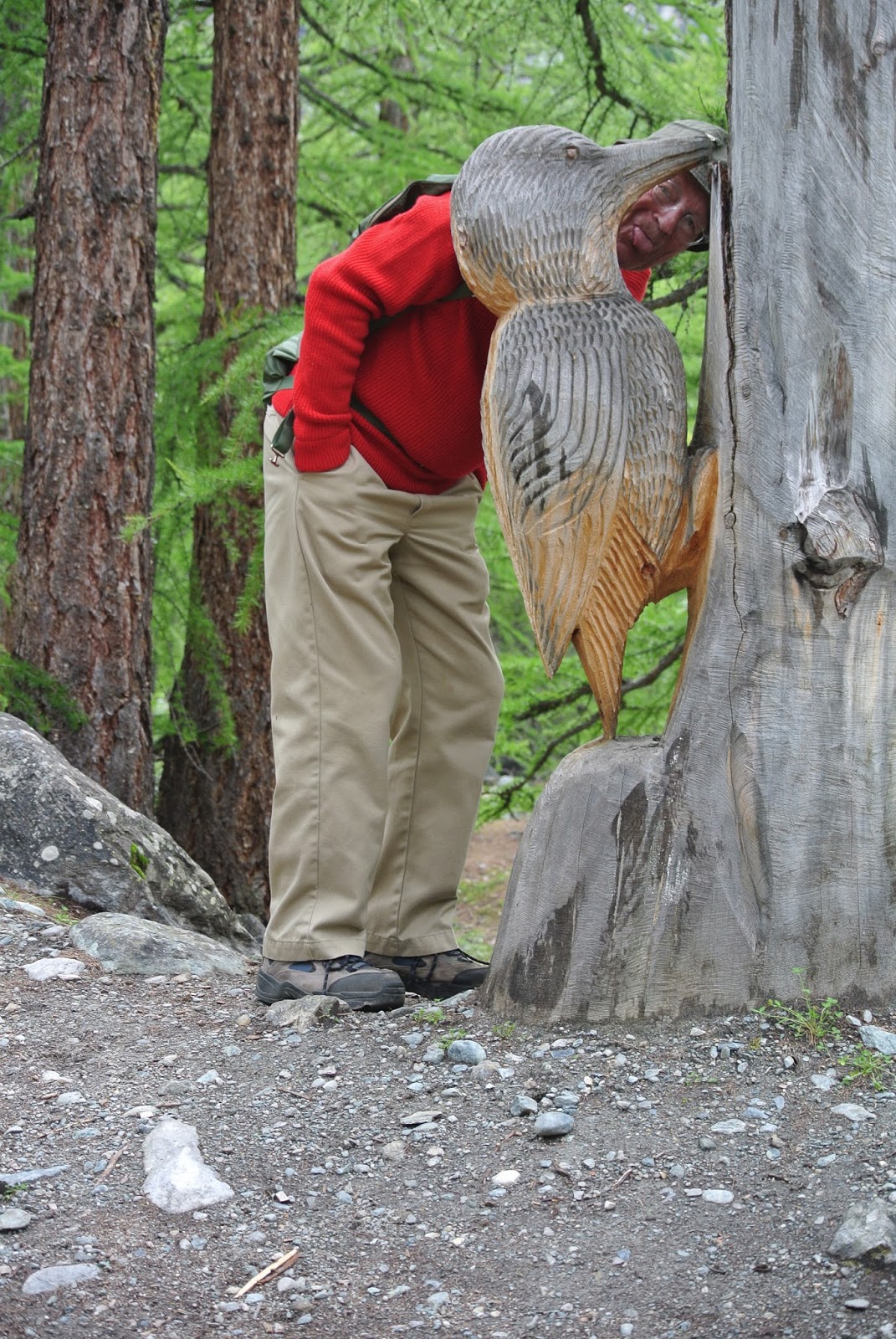
AND MORE RECENTLY, we have spotted a couple of carved statues along mountain trails depicting two oversize "species" of Mittlespecht  –  woodpeckers, although I tend to think of them as cuckoo birds  –  actively attacking forest trees.


IN FACT, on a recent birding trek in this land of the clouds, we were alarmed to spy a menacing creature approaching one of the native carvings.


More research is clearly needed to identify this latest interloper. It's possible this is the rare "funny hatted, red-sweatered, mountain marauder" that has been sighted in late summer in Zermatt for many decades. Caution is advised.

A HOUSE PARTY

IN FAIR WEATHER OR FOUL, the porch of the Hotel Christiania is a first-rate spot to enjoy life on our planet Earth. We recently found some snapshots that recall a sunny summer day (part of our look back at some good times in Zermatt) when the Peter Franzen-Bieri family invited their guests to celebrate life in the mountains.
Photo from https://www.christiania-zermatt.com
Hotel Christiania's Franzen-Bieri family on the terrace: Kathie and Peter, flanked by their sons Michel (left) and Domenic (right). 

REZEPT (RECIPE): Take one of the sunniest, most scenic terraces in town and fill it with special guests, good music, wine, laughter, and -- oh, yes -- the luscious aroma of melting raclette. You have the makings of a memorable party.


Michel (left) warms the Raclette machine as Kathie (right) plans logistics with the unflappable Pedro (center)


The music plays and the young ones jump up to dance...


While a guy in a funny mountain hat and other guests 
wait for their Raclette plates to arrive

Michel serves plates of molten raclette 

And the guy in the funny mountain hat shows Michel exactly which table
should receive a plate of raclette ASAP

While the Matterhorn watches in silent splendor over us all

SETTLING IN

ONE OF OUR ANNUAL RITUALS is "greeting the mountain." This year, when we arrive in the afternoon, we find the whole mountain iis visible despite the high overcast.


As in other years weather seems to be obeying one of the basic facts of nature  – it's always in flux. As we watch, the clouds gather and pull a veil across the Matterhorn's upper face.


But just as quickly, the veil is swept away. As the weather clears, the near meadows show a vibrant green, which augurs well for a robust fireworks display on the Swiss national day, August 1. (Last year the fireworks were cancelled throughout the nation because of drought.)


And the day ends well, with the sun breaking through for an evening panorama from the front porch -- or terrasse, as the hotel calls it.


So good to be back! (But notice the thin, dark clouds amassing once more.) What's next? Only time will tell...

Wednesday, July 27, 2016

THE SILENT TREATMENT

WE TOOK THE NEW, EARLIER 5 PM plane from Logan, to arrive at dawn in Zurich. By the time we reached the train station, the local time was 7 AM and the Tourist Office was just opening. It was a simple matter to buy tickets and reach the platform for the 7:40 Intercity to Zermatt, and we managed to climb aboard what WE THOUGHT was the right car. Heaving a sign of relief, we stowed our luggage and dropped gratefully into the handicapped seats right next to the door. Then we saw the sign on the window.


We had managed to land in an "absolute silence" club car! Already our fellow passengers were only too "vocal" in their shushing gestures, standing with fingers on their lips, indicating that we dare not even speak in the most subdued whispers. Well, there was no way we could drag all our luggage to the upper car! And so the "hush-hush set" welcomed us to Europe.

It's amazing how loud every sound is when NO SPEAKING whatsoever is allowed. Every sibilant blast of the car door opening, every word of the subdued station announcements, and the deafening roar of the train as it races through frequent tunnels. Only the conductor who punched the tickets was allowed to speak (no one dared to shush him!)

And so we were policed by our fellow travelers, all the way across the country. After Bern, when only a single passenger besides ourselves remained, we leaned our heads together and exchanged a few quiet words. From the other end of the car came the angry snap of newspaper pages being turned. The only sound of normal human commerce was the pleasant laughter of several women in the next car.

When we reached Visp, the paper-snapper joined us on the departure platform at the end of the quiet car. As he prepared to disembark, he set down his leather briefcase and smoothed his silvery hair and navy blazer to put his best foot forward. When we pulled into the station and the train stopped, he pantomimed instructions that I should exit to the right. "Surely we can use words now," I smiled, and reached up to push the green button that would open the door to the platform.

"No, no," he insisted, as he jerked my hand from the button. Startled, I pulled away. Meanwhile, the sociable ladies from the next car had arrived. One of them quickly wrenched his hand aside and pressed the button to open the door. I stood back and let the Swiss sort it out.

Wednesday, June 22, 2016

A CHARM OF GOLDFINCHES


I’ve never seen An Exaltation of Larks (except for the book by James Lipton), but have seen a vast murmuration of thousands of starlings in early winter over 6-lane Route 3 here in Massachusetts. (How do they dip and weave in their Moebius bends and still avoid sending their neighbors crashing to the ground?)

But we had a new experience yesterday in the brush between the garden and the lower pond, as a mob of several dozen still-gold finches came crashing all about us in an exuberant rapture of activity, weaving magically among the branches and twittering loudly among themselves. 


We had no camera with us, so had to search the internet for an image that most closely resembled what we saw. (Thanks to the anonymous online photographer who had a camera at the ready!)

Were the goldfinches celebrating some midsummer ritual, clamoring for the rich supply of local bugs, or as our local bird guru has wondered, anxious parents taking young ones out for their first drive (and hoping they wouldn’t accidentally take out every mailbox on the street?)

Lipton also calls this a “glister” of goldfinches. And with the bears of Wall Street advising that we all invest in gold now, we can imagine no more rewarding investment than the several minutes we were flashed by this mob.

Friday, November 21, 2014

MOUNTAIN DREAMS FROM HOME

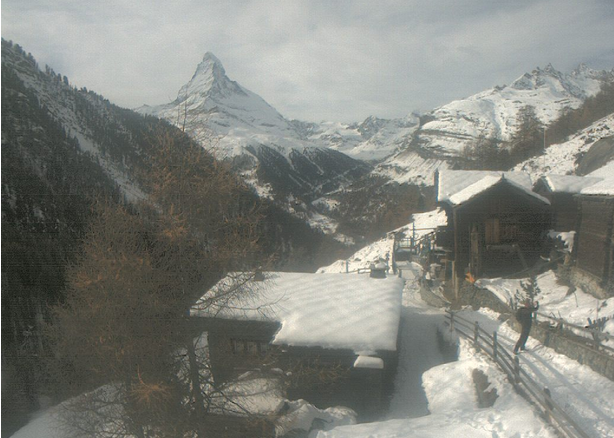
SNOWMAGEDDON in Buffalo NY brings thoughts of the Swiss Alps, where the snow belongs. I was drawn to the Zermatt webcams, curious to know if the snow had started there. And so it has. Even a webcam mounted at the Schonegg Hotel, next door to the Christiania, shows a light snow cover in the village.


HEADING slightly out of town, the webcam for the village of Findeln shows early season snow cover -- a far cry from the flower-strewn fields we visited in August.


Brings dreams of hopping a plane to see the world in snowy glory.


Winter can be beautiful!

Wednesday, August 13, 2014

EINE ÜBERRASCHUNG (SURPRISE!)

THE HOTEL HAS A TENNIS COURT just below the room, and it's fun to watch parents play patball with their youngsters, or more adept adults volleying with impressive slice and placement.  But an unusual crowd had gathered on the court one day, with tennis shoes but no rackets -- and using no hands at all.


There were eight of them -- four to a side -- and an onlooker who we believe was the coach. We found out later they were the Swiss ski team, who had practiced on the glacier at Klein Matterhorn in the morning, and were now in town playing a little "football" over the net. Perhaps not at a World Cup pace, but with an impressive array of head, chest and knee shots, they set up the ball and found ways get it over the net for the highest-scoring soccer match we're ever likely to see. 

PS: That's the Vispa river, which runs through town and collects all the snowmelt -- starting from Zermatt's 4000-meter peaks and tumbling down the valley to the Rhone River some 23 miles away and two miles lower in altitude. The Vispa alone generates vast amounts of low-cost power. It also provides a comforting white noise (which rises occasionally to a menacing roar) as it passes the hotel.